How To Install Extra Packages In Cygwin

Installing and Updating Cygwin for 64-bit versions of Windows
Run setup-x86_64.exe any time you want to update orinstall a Cygwin package for 64-bit windows. The signature for setup-x86_64.exe can be used to verify the validity ofthis binary.
Installing and Updating Cygwin for 32-bit versions of Windows
Run setup-x86.exe any time you want to update orinstall a Cygwin package for 32-bit windows. The signature for setup-x86.exe can be used to verify the validity ofthis binary.
Signing key transition
But here’s a hint: you need to visit the git web page, and install git for Windows. If you prefer a GUI client I recommend tortoise git, you will need to install this separately. INSTALLING EMACS Cygwin. The first task is to install Cygwin. Cygwin is a repository of GNU tools for Microsoft Windows. Cygwin has a nice setup program that downloads and installs the necessary Cygwin packages for you. Open the Cygwin, page in your web browser. Click on the 'setup-x8664.exe' (64-bit installation) or 'setup-x86.exe' (32-bit installation) link to download the appropriate setup program from the primary Cygwin server. Save it to the directory that you would like to store the downloaded packages in (e.g. Install a set of Cygwin packages required for building GCC. From within Cygwin, download the GCC source code, build and install it. Test the new GCC compiler in C14 mode using the -std=c14 option. Update: As a commenter points out, you can also install native GCC compilers from the MinGW-w64 project without needing Cygwin. # Cygwin 1.7's setup.exe introduces a -P switch which takes a list of extra packages. Setup needs to be run from a cmd window, not from bash. Drag the shortcut to setup.exe from your Desktop into the cmd window. # install all the packages in cygwin: cd path/to/downloads/cygwin. The command is provided by a package called cabal-install. It can be installed using ghcup, and cabal is also part of the Haskell Platform, other methods are listed at Distributions. The Cabal-Install page explains how to use cabal. If you so wish, you can still install packages manually - see the section below. Installing packages manually.
The key used to sign setup binaries has been updated. During the transitionperiod, signatures are made using both old (676041BA) and new (1A698DE9E2E56300)public keys here.See thismail for more details.General installation notes
When installing packages for the first time, the setup programdoes not install every package. Only the minimal base packagesfrom the Cygwin distribution are installed by default, which takes up about 100 MB.
Clicking on categories and packages in the setup program package installationscreen allows you to select what is installed or updated.
Individual packages like bash, gcc, less, etc.are released independently of the Cygwin DLL, so the Cygwin DLL version is notuseful as a general Cygwin release number. The setup programtracks the versions of all installed components and provides the mechanismfor installing or updating everything available from this site forCygwin.
Once you've installed your desired subset of the Cygwin distribution,the setup program will remember what you selected, so re-running itwill update your system with any new package releases.
On Windows Vista and later, the setup program will check bydefault if it runs with administrative privileges and, if not, will tryto elevate the process. If you want to avoid this behaviour and installunder an unprivileged account just for your own usage, runsetup with the --no-admin option.
Q: How do I add a package to my existing Cygwin installation?
A: Run the setup program and select the package you want to add.
Tip: if you don't want to also upgrade existing packages, select 'Keep' at thetop-right of the package chooser page.
Q: Is there a command-line installer?
A: Yes and no. The setup program understandscommand-linearguments which allow you to control its behavior and chooseindividual packages to install. While this provides some functionalitysimilar to such tools as apt-get or yum it is not asfull-featured as those package managers.
Q: Why not use apt, yum, myfavourite package manager, etc.?
A: The basic reason for not using a more full-featured package manager is thatsuch a program would need full access to all of Cygwin's POSIX functionality. Thatis, however, difficult to provide in a Cygwin-free environment, such as exists onfirst installation. Additionally, Windows does not easily allow overwriting ofin-use executables so installing a new version of the Cygwin DLL while a packagemanager is using the DLL is problematic.
Q: How do I install everything?
A: You do not want to do this! This will install an enormous number of packagesthat you will never use, including debuginfo and source for every package.
If you really must do this, clicking on the 'Default' label next to the'All' category to change it to 'Install' will mark every Cygwin package forinstallation. Be advised that this will download and install tens of gigabytesof files to your computer.
Q: How do I verify the signature of setup?
How To Install Cygwin Packages
A: e.g.
Q: What's the hash of setup?
A: See here
Q: How do I help improve setup?
A: See the setupproject page for more information.
Download/Install the Cygwin Toolset
Cygwin Install Additional Packages
Cygwin is a collection of GNU and Open Source tools that provide a Linux-like environment for Windows: using it we can install and use llvm (which includes the GCC compilers), Clang (which includes Clang compilers), GDB (a debugger used by both compilers), and make/cmake (tools that which we use to specify how to build -compile and link- C++ programs). Cygwin and it toolset occupy about 14 GB on disk.
In this handout you will download and install the Cygwin toolset; in the next you will download a version of CLion, an Integrated Development Environment (IDE) for using these tools (or you can choose to use these tools via a command-line).
You may want to print these instructions before proceeding, so that you can refer to them while downloading and installing Cygwin and its toolset. Or, just keep this document in your browser. You should read each step completely, before performing the action that it describes.
Cygwin Toolsest
Downloading and Installing
- Click Cygwin64
The following Cygwin home page should appear in your browser.
- Click the setup-x86_64.exe link on that page, and use it to download that executable file: executing this file will install the 64-bit version of Cygwin.
On some browswers you will be prompt to Run or Save this file. Choose to Save it.
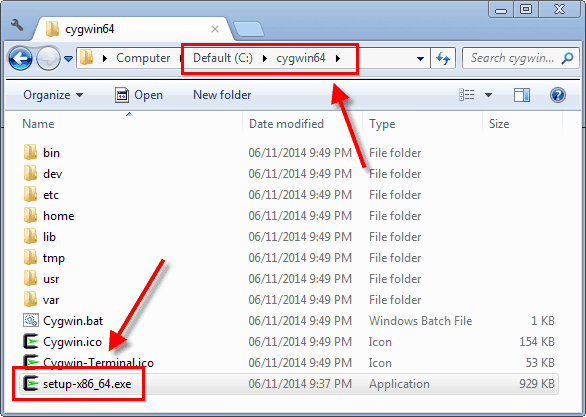
After downloading this file, its icon will appear on your screen as follows.Save this file for future use, in case you need to install more Cygwin tools: on my system I stored this file as C:ZDataInstalled Softwaresetup-x86_64.exe; I mention this because that directory will appear in later screen-shots.
- Double-click the setup-x86_64.exe file.
When run, your screen will be show a message with the questions, Do you want to allow this app from an unknown publisher to make changes to your device.
- Click the Yes button on your screen.
The following Cygwin Setup pop-up window should appear on your screen.
- Click the Next> button on this window.
The following Cygwin Setup - Choose Installation Type pop-up window should appear on your screen.
Ensure the Install from Internet radio button is pushed (the default).
- Click the Next> button on this window.
The following Cygwin Setup - Choose Installation Directory pop-up window should appear on your screen.
For simplicity and consistency, ensure the Root Directory is C:cygwin64 (the default); the All Users (RECOMMENDED) radio button should be pushed (the default).
- Click the Next> button on this window.
The following Cygwin Setup - Select Local Package Directory pop-up window should appear on your screen.
This is a temporary directory in which Cygwin will create folders that it downloads files into; it will delete the files/folders here before finishing. For simplicity and consistency, use the default Local Package Directory.
- Click the Next> button on this window.
The following Cygwin Setup - Select Connection Type pop-up window should appear on your screen.
Ensure the Direct Connection radio button is pushed (this second radio button is the default).
- Click the Next> button on this window.
A progress window might temporarily flash on the screen. The following Cygwin Setup - Choose Download Site(s) pop-up window should appear on your screen.
There are many sites from which Cygwin can be downloaded. I would leave the top one (http://cygwin.mirror.constant.com) selected (the default).
- Click the Next> button on this window.
A progress window might temporarily flash on the screen. In the View pull-down list, select Category if it is not already selected. The following Cygwin Setup - Select Packages pop-up window should appear on your screen. (I have midimized this window and enlarged the result horizontally)
Notice that the Search textbox is empty.
In the steps below you enter tool names and will specify installing Develment for each.
At the end of this process, after selecting all packages, you will click the Next> button. Do not prematurely click the Next> button.
First, click on the + in the square to the left of All. The contents of the Cygwin Setup - Select Packages pop-up window should now appear as
- Type llvm into the textbox; the possible tools related to this name will appear in the window. When they do, to the right of just Devel(4) click the pull-down menu and select Install.
The following Cygwin Setup - Select Packages pop-up window should appear on your screen.
Do NOT click Next> yet! Follow the instructions below, to type a new word in the Search textbox.
- Type clang into the textbox; the possible tools related to this name will appear in the window. When they do, to the right of just Devel(5) click the pull-down menu and select Install (although it should already be showing Install, because Devel was selected prior).
The following Cygwin Setup - Select Packages pop-up window should appear on your screen.
Do NOT click Next> yet! Follow the instructions below, to type a new word in the Search textbox.
- Type libiconv into the textbox; the possible tools related to this name will appear in the window. When they do, to the right of just Devel(1) click the pull-down menu and select Install (although it should already be showing Install, because Devel was selected prior).
The following Cygwin Setup - Select Packages pop-up window should appear on your screen.
Do NOT click Next> yet! Follow the instructions below, to type a new word in the Search textbox.
- Type gdb into the textbox; the possible tools related to this name will appear in the window. When they do, to the right of just Devel(4) click the pull-down menu and select Install (although it should already be showing Install, because Devel was selected prior).
The following Cygwin Setup - Select Packages pop-up window should appear on your screen.
Do NOT click Next> yet! Follow the instructions below, to type a new word in the Search textbox.
- Type make into the textbox; the possible tools related to this name will appear in the window. When they do, to the right of just Devel(27) click the pull-down menu and select Install (although it should already be showing Install, because Devel was selected prior).
The following Cygwin Setup - Select Packages pop-up window should appear on your screen.
Do NOT click Next> yet! Follow the instructions below, to type a new word in the Search textbox.
- Type cmake into the textbox; the possible tools related to this name will appear in the window. When they do, to the right of just Devel(5) click the pull-down menu and select Install (although it should already be showing Install, because Devel was selected prior).
The following Cygwin Setup - Select Packages pop-up window should appear on your screen.
Do NOT click Next> yet!
Cygwin automatically installs the vim text editor. If you would like to install the emacs editor
Type emacs into the textbox; the possible tools related to this name will appear in the window. When they do, to the right of just Devel(5) click the pull-down menu and select Install (although it should already be showing Install, because Devel was selected prior) and do the same with Editors(9).
The following Cygwin Setup - Select Packages pop-up window should appear on your screen.
- Type llvm into the textbox; the possible tools related to this name will appear in the window. When they do, to the right of just Devel(4) click the pull-down menu and select Install.
- (Finally!) Click the Next> button on this window.
If this is your first installation of Cygwin, you may see the following Cygwin Setup - Review and confirm changes pop-up window on your screen (its pane contents might display different installs).
If you have a previous installation of Cygwin, you may see the following Cygwin Setup - Review and confirm changes pop-up window on your screen (its pane contents might display different uninstalls).
If you see either of these pop-up windows, click Next>.
If this is your first installation of Cygwin, you may see the following Cygwin Setup - Resolving Dependencies pop-up window on your screen (its pane contents might display different information).
If you see this pop-up window, click Next>.
- The following Cygwin Setup progress pop-up window should appear on your screen.
It will cycle through the Downloading, Installing, and Running tasks. Downloading itself might take minutes (depending on your connection speed); Installing and Running can also take minutes. On my machine, with a fast connection speed, the entire process took about 15 minutes; sometimes it will pause for up to tens of seconds (often with 0% progress showing on the window); let it finish. My installation also occupied about
Eventually this window will be replaced by the following Cygwin Setup - Installation Status and Create Icons window on your screen.
I recommend that you leave checked the Create icon on Desktop checkbox, and uncheck the Add icon to Start Menu checkbox.
- Click the Finish button on this window. Place the (Cygwing64 Terminal icon) on your desktop in convenient place (especially if you plan to use this Cygwin toolset with a Command Line instead of CLion).
- Finally, place C:cygwin64bin on the Path, so that the Cygwin toolset is available for use.
- Right-click Start (lower-left on Start menu)
- Click Search
- Type env into search box
- Click Edit the system environment variables/Control Panel
- Click the Environment Variables... button.
The following Environment Variables pop-up window should appear on your screen.
- In the System variables (lower) part, scroll to line starting with Path and click that line (which should become highlighted).
IMPORTANT: Even though you see a Path in the User variables (top part) look for Path in the lower part to change it.
- Click Edit... beneath this part.
- Copy the text C:cygwin64bin An Edit environment variable pop-up window should appear on your screen.
- Click New (upper-right)
- Paste the copied text (or just retype it) in the line at the bottom created by New.
When done, the Edit environment variable pop-up window should look something like
- Click OK for each of the pop-up windows above, to terminate them (3 OKs total), and delete (X) the System window.
The Cygwin toolset (all the necessary programming tools) are now installed. You are now ready to install the CLion IDE; as an alternative you can also first test that you downloaded Cygwin correctly by following the instructions in Command Line Cygwin Tools.
Add Packages To Cygwin